I Just Wanted a Glass of Coke: Why Vibe Coding Is Losing the Plot

"I’d love a cold glass of Coke, please."
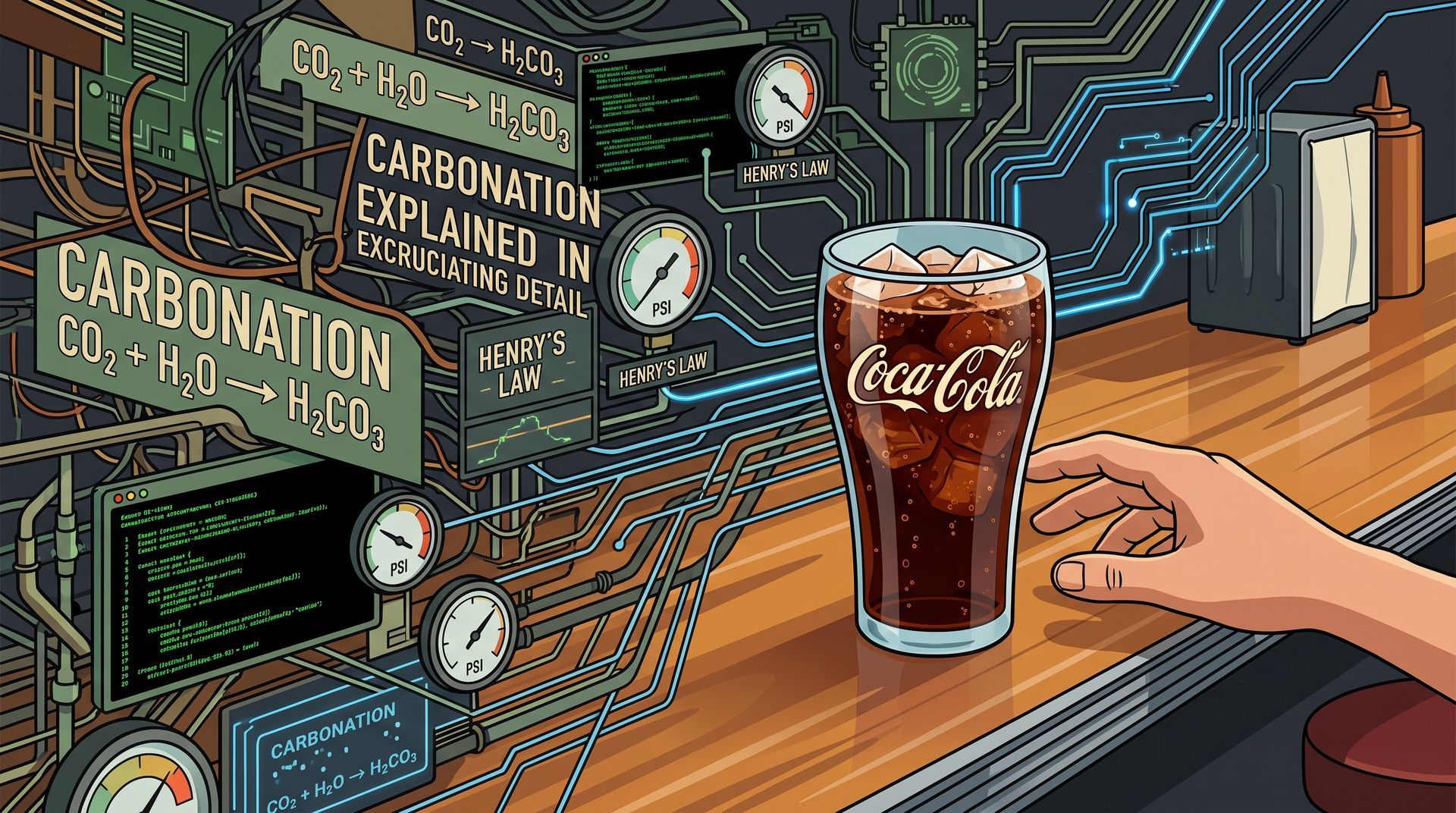
Imagine walking into a diner on a sweltering afternoon, parched, sliding onto a stool, and saying, "I’d love a cold glass of Coke, please."
Instead of reaching for a glass and pulling the tap, the person behind the counter leans in with wild eyes.
- "Well, first we need to talk about Henry’s Law," they say, grabbing a whiteboard marker. "You see, what makes this beverage viable is forcing carbon dioxide into an aqueous solution under four atmospheres of pressure. When the pressurized headspace equalizes with the ambient atmosphere, the carbonic acid destabilizes, which creates the effervescence you perceive on your tongue. Now, do you want me to spin up a secondary CO2 regulator container, or should we pipe the pressurized syrup via a custom sub-millimeter nozzle directly into the ambient environment?"
You stare at them, your throat burning. I just want a Coke.
That diner scenario is the exact nightmare happening right now in the world of "vibe coding."
The promise of vibe coding was supposed to be pure magic. You sit down, talk to an AI in plain human English, and describe what you want built. No deep syntax memorization, no wrestling with esoteric compiler errors, just pure creative flow: “Build me a clean customer intake form that sends an email alert and logs the data to a spreadsheet.”
It sounded like the ultimate democratizer of technology. Finally, regular business owners, creators, and everyday problem-solvers could bypass the jargon wall and just build things that work.
Then reality set in.
The second a build hits a tiny snag or requires a basic integration, the vibe disappears, replaced by an avalanche of unprompted, hyper-technical weeds. You tell the tool the submit button isn't sending the email, and instead of quietly fixing the plumbing under the hood, it dumps three paragraphs about asynchronous webhook listeners, headless API authentications, JSON payload serialization, and why you really ought to refactor your state management into a serverless edge worker.
Regular users don’t care about the molecular physics of carbonation. They don't care what kind of gas tank sits in the basement, what the PSI is, or how the tubing was extruded. They just want the soda in the glass, cold, with ice.
When tech gets obsessed with showing its work instead of solving the problem, it alienates the very people it was built to empower. A good tool hides complexity; bad execution flaunts it. If building a simple digital tool requires wading through endless technical gatekeeping disguised as "collaborative prompting," the magic is gone.
Until these tools learn the art of the quiet fix—doing the heavy lifting in the background and handing over a working product—vibe coding will keep stumbling over its own ego.
If someone asks for a drink, don't explain the chemistry.
Just hand them the glass.
That being said, the landscape of "vibe coding" tools is incredibly promising, though the experience remains wildly inconsistent across platforms. Because each tool interprets intent differently, the search for the right interface is less about technical specs and more about finding a synergy in communication.
You truly need to experiment with multiple environments to find the one that resonates with your specific way of thinking. It raises an interesting question: is the success I'm seeing with my current favorites a result of superior tool architecture, or have I simply become more adept at refining my prompts to match their specific "language"? It is likely a feedback loop where both the user and the model are slowly learning to meet in the middle.
Key takeaways for navigating vibe coding tools:
- Prioritize Intuition:
Choose platforms that prioritize results over "showing their work" via unnecessary technical explanations. - Iterative Testing:
Don't settle for the first tool you try; test your specific use cases across several platforms to see which handles your logic best. - Prompt Engineering is Personal:
Acknowledge that the way you describe tasks is a unique skill that improves with each tool you master. - Focus on the Output:
If a tool constantly requires you to troubleshoot its own technical explanations, it is failing the core promise of "vibe coding."